

48 hours only! Get 20% off progressive lenses | Use code: GET20


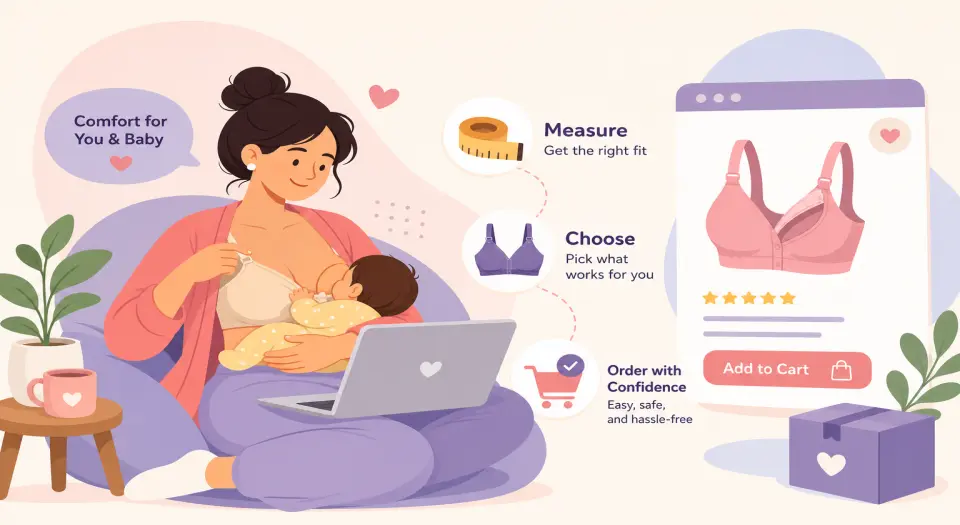
Feeding bra online: how to choose, measure, and order right
June 29, 2026
Buying a feeding bra online without being able to try it first feels like a gamble, especially when your body is changing week to week. You measure, you second-guess, you order, and then it arrives and fits nothing like you expected. Many readers find listicle-style guides unhelpful, they list fifteen bras with no real explanation of what separates a genuinely useful breastfeeding bra from one that'll sit in your drawer after three uses.
This guide cuts through that. You'll learn which features actually matter, how to measure yourself at home without getting it wrong, which mistakes to skip, and where to shop if you're in Bangladesh. MaaMio is a Bangladesh-based online shop offering a curated selection of nursing and maternity bras, so local mothers can find what they need without sifting through irrelevant listings.
Why your regular bra fails the moment breastfeeding starts
The physical changes that demand something different
Breast size can increase by one to three or more cup sizes during pregnancy and the nursing period. Your band size shifts too, because the ribcage expands during pregnancy and contracts again after birth. A pre-pregnancy bra simply cannot track those changes, and wearing one that's too tight isn't just uncomfortable. It can press on milk ducts, raising the risk of blockages or mastitis. The fit of your bra is a health consideration, not just a styling one.
What wearing the wrong bra actually costs you
Picture a new mother trying to pull a regular bra aside mid-feed while the baby is already fussing, or wincing because an underwire is digging into swollen breast tissue the moment her milk comes in. Many breastfeeding mothers report exactly these frustrations when they stick with their old bras out of habit or uncertainty. Once you understand why the right breastfeeding bra matters, the decision to buy one becomes straightforward rather than optional.
The features that actually matter when you buy a feeding bra online
Access design: clips, drop cups, and front openings
There are three main ways a nursing bra gives you feeding access. Drop-cup designs unfold the cup downward after you release a clasp near the strap. Strap-based one-hand clips unhook near the shoulder and let you open one cup at a time. Front-opening nursing bras have a clasp between the cups that separates the whole front for quicker, wider access. One-hand access is the practical standard, especially in the early weeks when you're operating on little sleep and need things to work without concentration.
A clip that genuinely works one-handed is easy to distinguish from one that doesn't. If you need your thumb and two fingers while your other hand supports the baby, that's a two-hand clip in disguise. Look for clasps that release with a single thumb press, a simple test you can do before committing to a purchase. Front-opening styles suit mothers who find strap clips fiddly or who want to switch sides quickly during a feed. Both are worth knowing about when you order feeding bras online, because product photos don't always show the mechanism clearly.
Fabric and construction: what to check for when shopping online
Soft, breathable fabrics are the benchmark for any bra you'll wear for hours at a time while nursing. Cotton, bamboo, modal, and cotton-spandex blends are the most practical choices for postpartum and nursing wear because they're gentle on sensitive skin, allow airflow, and flex as breast fullness changes throughout the day. For more on fabric choices and why organic cotton can help sensitive breasts, see the benefits of organic cotton bras for expectant and nursing moms.
Seamless construction reduces friction and seam irritation during long wear, which matters when you're putting on and taking off a bra multiple times a day. On padding: removable pads offer flexibility and let you adjust coverage, but they shift and need repositioning. Sewn-in or molded padding stays put, which is less fuss, though it adds warmth and doesn't accommodate size changes as well.
Wire-free vs. underwire: the clear answer for most nursing mothers
For the early weeks of breastfeeding, wireless nursing bras are generally the right call for most mothers. Underwire can work, but it has to fit precisely and sit completely clear of breast tissue, which is hard to guarantee when you're ordering online and your size is still changing. A wire that presses on a milk duct can contribute to blockages and mastitis. For mothers shopping for a feeding bra online without the ability to try first, a wireless nursing bra removes that risk while still providing solid support. If you want a detailed consumer-facing overview of the pros and cons, the Consumer Reports buying guide is a useful read.
The four nursing bra styles and when to choose each
Drop-cup and clip-down for everyday support
This is the most versatile option for daytime use. Drop-cup bras sit discreetly under regular clothing, provide reliable support, and give you quick feeding access in one motion. They pair well with most everyday tops and casual outfits, and the clasp mechanism is straightforward enough to release with one hand once you've practiced it a few times. They're a strong starting point for mothers who are out of the house regularly and need something that works across different outfits without looking like specialized gear.
Wireless and wrap styles for sleep and recovery
Soft pull-aside or wrap-around styles with no clips or clasps are ideal for night feeds and the first six to eight weeks of postpartum recovery, when soreness and engorgement are least predictable. They put minimal pressure on breast tissue and require almost no coordination to use at 3am. Nursing camisoles with built-in bra support fall into this category and are worth considering for home wear, since they cover the midriff and simplify layering for quick access during the day.
Padded and contour styles for when appearance matters
Once milk supply has regulated (usually around six weeks postpartum), some mothers want a smoother silhouette for outings. Padded or contour nursing bras help reduce nipple show-through and keep nursing pads positioned correctly. The trade-off is less breathability and less flexibility during size fluctuations. These styles work well as a second or third bra in your rotation, not as your first purchase.
How to measure for a feeding bra at home before you order
The two measurements you actually need
Band size: wrap the tape measure snugly under your bust, keep it level at the back, and don't compress the skin. Round to the nearest whole number. Cup size: measure around the fullest part of your bust, subtract the band number, and match the difference to the brand's cup size chart. This second step is where most people go wrong, they use a generic chart instead of the one published by the specific retailer they're ordering from. Brand sizing varies, so always use the chart from the store you're buying from. For practical step-by-step fitting tips, refer to a dedicated guide on finding a nursing bra in the right size.
When to take your measurements (timing changes everything)
The best window for measuring during pregnancy is 35 to 37 weeks, when breast size is closest to what it will be in early postpartum. If you're already nursing, measure before a feed or around midday when breasts are full. Measuring after an early-morning feed gives a deflated reading that makes your cups feel too big once you're fuller later in the day. Getting the timing right means the size you order will actually fit across more of the day, not just the moment you try it on.
How to use brand sizing charts without getting confused
If you land between two sizes, sizing up in the cup rather than the band is a widely recommended approach, adjust based on brand-specific fit notes and your own support needs. The band is what provides support; a slightly larger cup simply accommodates fullness changes without creating a fit problem. A cup that's too small compresses tissue. A band that's too loose gives no support at all. Measure on the day you order, not a week earlier, and reassess if your body changes before the parcel arrives. For visual fitting advice and common adjustment tips, see this maternity nursing bra fitting guide.
Mistakes that turn an online nursing bra order into a return
Ordering in your pre-pregnancy size
This is the most common mistake, and it's easy to understand why it happens. Ordering your usual size feels automatic. But breast and band size both shift significantly during pregnancy and after birth, and a bra ordered in your pre-pregnancy size will almost certainly be too tight in the band or too small in the cup within weeks of arriving.
Choosing a bra that doesn't leave room for size changes
Milk supply regulates around six weeks postpartum, but breast size fluctuates daily with every feed throughout the nursing period. A bra with rigid cups or a single hook-and-eye closure will become uncomfortable quickly as your body shifts. Look for multiple hook-and-eye settings on the band and stretchy cup panels when you're shopping for feeding bras online. These construction details give you practical range as your size changes without requiring a new bra every few weeks.
Prioritizing looks over function too early in the nursing stage
A heavily structured, fashionable maternity bra might be the right choice at three months postpartum. In the first few weeks, softness and ease of access matter far more than how it looks under a fitted top. The practical approach: buy one or two functional wireless nursing bras first. Add padded or contour styles once your size has stabilized and you have a clearer sense of what your daily routine actually requires.
Where to buy feeding bras online in Bangladesh
What to look for in a local online retailer
Reliable delivery timelines, a clear exchange or returns policy, accurate product descriptions with fabric content listed, and a range of sizes covering the typical nursing spectrum are the baseline requirements. Generic e-commerce platforms in Bangladesh often carry nursing bras as an afterthought, with limited size options, no sizing guidance, and product photos that don't show the access mechanism clearly. Prices across the local market range from around BDT 300 for budget options up to BDT 1,100 or more for multi-packs and better fabric quality, so there's a meaningful range to navigate.
Why MaaMio is worth checking first
MaaMio is a Bangladesh-based online shop built specifically for mothers and families, carrying a curated selection of nursing and maternity bras rather than a scattered general inventory. The practical advantages are straightforward: home delivery across Bangladesh, products selected with local mothers in mind, and the ability to browse feeding lingerie alongside other postpartum essentials in one place. You're not cross-referencing a dozen separate listings to work out whether a product actually qualifies as a nursing bra or just looks like one in the thumbnail.
Making your first order go smoothly
Measure on the day you order. Check the brand's specific size chart, not a generic online calculator. Start with two bras, ideally in different access styles, to see what works for your feeding routine. Most breastfeeding mothers find they need three to five nursing bras total for a practical rotation, but two is a sensible starting point until you know what you're actually reaching for each day.
Your next step
The core decisions come down to a few clear points: choose an access style that fits your daily routine, prioritize soft wire-free fabric in the early weeks, measure at the right time of day, and don't order in your pre-pregnancy size. None of this is complicated once you know what you're looking for. The hard part is usually just knowing where to start.
For mothers in Bangladesh who want a curated selection without the guesswork, MaaMio is worth bookmarking before you open another tab. When you're ready to order a feeding bra online, take your measurements that day, use the retailer's size guide, and start with two styles so you have a working rotation from the beginning.