

48 hours only! Get 20% off progressive lenses | Use code: GET20


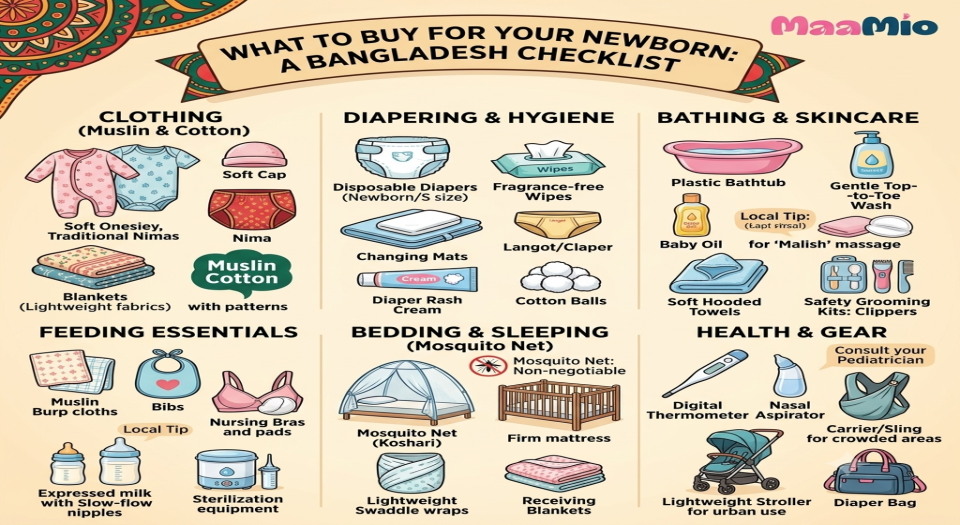
What to Buy for Your Newborn: A Bangladesh Checklist
August 06, 2026
If you're wondering what to buy for your newborn in Bangladesh, you're not alone, and you're probably already overwhelmed. Open any baby product website and suddenly there are 47 things you apparently need before the baby arrives. Wipe warmers. Nappy bins with special cartridges. A "nursery starter kit" that costs more than a month's groceries. Most of it is marketing dressed up as necessity.
This baby shopping checklist cuts through that noise. What follows is a category-by-category breakdown of what you genuinely need for a newborn in Bangladesh, with realistic quantities and practical buying guidance built for local parents. Most of these items can be sourced in one place rather than scattered across a dozen sites. Specialist retailers like MaaMio exist specifically for this purpose, which saves you the exhausting work of vetting sellers one by one.
The five categories covered here are clothing, sleep setup, feeding supplies, nappies and bathing, and health essentials. Each section tells you what to buy for your newborn, how many to buy, and where the optional extras end and the genuine must-haves begin.
1. Newborn clothing: what you need and how many to buy
Quantities that actually make sense
The quantities are simpler than most lists suggest. Aim for 6, 8 bodysuits, 4, 6 zippered sleepers, 4, 6 pairs of socks, 2, 3 hats, 2, 3 pairs of mittens, and one coming-home outfit. That is genuinely enough. Newborns need 2, 4 outfit changes per day, so this gives you enough clothing to last 2, 3 days between laundry cycles without a mountain of tiny garments cluttering the wardrobe.
One of the most common newborn shopping mistakes is over-buying in newborn size. Babies move into 0, 3 months sizing remarkably fast, sometimes within weeks. Buy the majority of your clothing in 0, 3 months and keep only a small number of newborn-size pieces for the very first days.
Seasonal tips for Bangladesh
Bangladesh's climate matters here. For most of the year, the country is warm and humid, which means heavy fleece suits and thick layered outfits are unnecessary. Prioritise lightweight cotton bodysuits and short sleepers for summer babies. If your baby arrives between November and February, add 2, 3 lightweight cardigans or jackets to the list. Zippered sleepers are strongly recommended over button-up styles for nighttime changes, fumbling with snaps at 3am is its own special kind of misery, and that holds true in any season.
Buy neutral, easy-wash pieces rather than delicate embroidered sets. Newborns soil clothing constantly, and those fancy outfits rarely survive the first week intact. Gifted clothing also tends to flood in after a baby arrives, so hold back on purchasing beyond the basics before birth. Fill the gaps once you see what actually comes through the door.
2. What to buy for newborn sleep: setting up a safe sleep space
The core sleep kit is straightforward: a firm, flat-surface crib or bassinet with a snug-fitting mattress, 2, 3 fitted sheets, 3, 4 swaddle blankets, and 1, 2 wearable sleep sacks. The reason for multiple fitted sheets is entirely practical. Newborns soak through sheets overnight with surprising regularity, and having a spare means you are not hunting for clean bedding at 2am. A room thermometer is a low-cost addition worth having to confirm the sleep environment stays at an appropriate temperature.
There are specific products you should avoid outright. Safety authorities including the AAP (American Academy of Paediatrics) and recent US regulation advise strongly against inclined sleep surfaces above 10 degrees, as infant fatalities have occurred. For recent recalls and official guidance, see the CPSC recall on convertible bassinets and an overview of the AAP safe sleep guidelines. The term "banned internationally" overstates things, regulations vary by country, but the safety case is clear and consistent across major health bodies. Regardless of where these products are sold locally, do not use them. Baby loungers and nursing pillows are for supervised awake time only and should never serve as sleep surfaces.
The crib must stay completely bare, no pillows, no loose blankets, no stuffed animals, no bumper pads. A fitted sheet on the mattress is the single exception; everything else is a safety risk, not a stylistic choice.
White noise machines and night lights are nice-to-haves rather than essentials. Many parents use a fan or a free white-noise app as a low-cost alternative to a dedicated machine. Co-sleepers and bedside bassinets are useful if you plan to room-share, but a standard firm crib placed in your room covers the same ground.
3. Feeding supplies for breastfeeding and formula feeding
If you plan to breastfeed, your core list includes 3, 5 nursing bras, two packs of nursing pads, and nipple cream. A breast pump is optional depending on your situation: manual pumps in Bangladesh typically cost between ৳1,500 and ৳2,000, while electric pumps from reliable brands run ৳8,000 to ৳12,000. Even if you intend to breastfeed exclusively, have 4, 6 slow-flow bottles on hand for expressed milk or the occasional top-up. Burp cloths are non-negotiable regardless of feeding method: 6, 8 is the right number, and you will use every single one.
For formula feeding, increase your bottle count to 8, 10 in newborn size with slow-flow nipples, and add a bottle brush, a drying rack, and a steriliser or steriliser bags. Do not stock up heavily on formula before the baby arrives; start with one tin and adjust based on your baby's actual feed volume, which varies considerably in the first weeks. A thermos or bottle warmer is convenient for night feeds but is not a necessity.
Both feeding methods require bibs (6, 8) and muslin squares (6, 8), which double as burp cloths, impromptu sun shades, and general mess catchers. A nursing pillow makes feeding sessions significantly more comfortable for you, though a rolled towel or firm cushion works well enough in the beginning.
4. Nappies, changing essentials, and bath basics
Newborns need 8, 12 nappy changes per day, roughly every 2, 3 hours. For the first month, stock 1, 2 packs of newborn size and 3, 4 packs of Size 1 as your main supply. In Bangladesh, disposable nappies cost approximately ৳15 per piece, with jumbo packs of 20, 30 pieces running ৳520, ৳780 depending on the brand. Buy 4, 6 packs of fragrance-free baby wipes and 1, 2 tubes of zinc oxide nappy cream for rash prevention.
The question of disposable versus cloth nappies comes up for every new parent. For a clear comparison, see this cloth diapers vs disposable guide. Disposables are more convenient and more absorbent, making them the practical default for most families in the early weeks when laundry is already relentless. Cloth nappies are cheaper long-term and significantly more eco-friendly, but Bangladesh's high humidity makes air-drying harder and increases the risk of mildew if cloths are not dried thoroughly. A hybrid approach works well for many families: disposables for nights and outings, cloth during daytime at home once you have found your rhythm.
For bathing, the list is genuinely short: one bottle of gentle, fragrance-free baby wash, 1, 2 hooded towels, and a baby bath tub or bath seat for support. A waterproof changing mat with 2, 3 washable covers completes the changing station. Sponge baths are the correct method for the first 1, 2 weeks until the umbilical cord stump falls off, so you do not need the baby tub immediately after birth.
5. Health essentials and what to buy for newborn care, and what to skip
The health kit every parent needs ready before the baby comes home is short. A digital rectal thermometer is the most accurate option for newborns and costs very little; ear and forehead thermometers are not reliable for this age group. A nasal aspirator clears blocked airways when the baby is congested, this is more important than it sounds, because newborns cannot breathe through their mouths, so a blocked nose creates a real feeding and sleeping problem. Baby nail clippers or a soft file are necessary from around week two, as newborn nails are sharp enough to scratch a baby's own face.
Gripe water and gas drops are optional. Buy them only if your baby shows signs of wind or colic, not as a precaution. If you find you need them, they are inexpensive and widely available; buying them reactively rather than speculatively is simply smarter use of your budget.
First-time parents consistently over-purchase in certain categories. Elaborate nappy bags, wipe warmers, bottle warmers, video baby monitors with multiple cameras, and dedicated changing tables are all items that sound essential but rarely earn their price or space. A regular backpack functions perfectly as a nappy bag. A mat on a dresser or on the floor serves as a changing station. A thermos keeps water warm for feeds. Baby monitors are genuinely useful in large homes, but in many smaller Bangladeshi apartments you may not need one, though if your home is spread across multiple rooms or floors, it is worth reconsidering.
A rough budget estimate for context: without large-ticket items like a cot (which ranges from ৳8,000 to ৳27,000 depending on type) or a pram, a solid newborn items list in Bangladesh will typically cost ৳8,000, ৳18,000 depending on brand choices and quantities. This is an approximate range based on individual item costs; your actual spend will depend on what arrives as gifts and which categories you prioritise. Spreading purchases across the third trimester reduces financial pressure and lets you adjust as you go.
Where to buy newborn essentials in Bangladesh
MaaMio is a Bangladesh-based online store built specifically for mothers and newborns, not a general marketplace trying to cover everything. Parents can find clothing sets, feeding accessories, baby bedding, and gift options in one place, with nationwide delivery and a first-purchase discount. Their blog content is written with Bangladeshi parents in mind, so you can use MaaMio as both a buying resource and a shop in the same visit. As with any retailer, check product safety labels, approval marks, and recall databases before purchasing sleep products in particular.
For additional options, Monowamart and BabyShoppers are two retailers in Bangladesh, both offering original products with nationwide delivery and 7-day return windows. Babycare covers nappies, formula, and skincare from established brands if you need a top-up order. For parents who prefer to feel fabrics before buying, Clothxtra has an experience centre for in-person shopping.
If you want a quick checklist to cross-reference before you place an order, consider this newborn essentials checklist that summarises first-month needs. A few smart shopping habits before you check out: always verify that any sleep product lies completely flat with no incline above 10 degrees. Stick to your first-time parent baby checklist and resist the impulse to add items that "might be useful." Unboxed baby gear accumulates quickly, and a cluttered home with a newborn is its own problem. Many parents find it helpful to place their main order several weeks ahead of their due date to allow for delivery, any returns, and last-minute adjustments.
The short version: essentials first, adjust later
Most parents need far less than baby marketing suggests. Clothing in sensible quantities, a bare and firm sleep surface, feeding supplies matched to your feeding method, nappies and bathing basics, and a short health kit: that covers the genuine first-month needs on any newborn must-haves list for Bangladesh.
Working out what to buy for a newborn comes down to essentials first, then adjusting based on how your baby feeds, sleeps, and grows. Some babies need a nasal aspirator weekly; others barely need it. Some mothers find a breast pump indispensable; others manage without one entirely. Buy the core list, see what your baby actually needs, and fill in from there.
If you want a trusted starting point that covers most of what to buy for baby in one order, MaaMio's newborn essentials range is a practical place to begin. Browse their Bangladesh-specific guides and get the foundation in place before your due date, without the stress of piecing everything together from multiple sellers.